Dad called Mark’s dented pickup an embarrassment. Then an old Navy veteran showed up at our door, looking for that truck after 20 years.
My father had a weekly ritual, and it wasn’t saying grace. Every Sunday, before the pot roast reached the table, he found a new way to insult my husband’s truck.
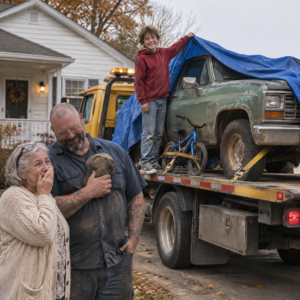
Mark drives a 1998 pickup, faded green, with a deep dent in the tailgate and a passenger door that has to be shut twice. It starts on the first try every morning. To my dad, Richard, a retired bank manager who trades in his sedan every three years, it was a personal insult parked in his driveway.
“Rust bucket,” he’d mutter as we walked in.
“Embarrassing,” he’d tell my mother, loudly enough for the neighbors to hear.
And his favorite: “A real provider drives something decent, Jenna.”
The brochure on the plate
Mark and I had been married six years. He runs a small HVAC repair business and stays late to fix a widow’s furnace for the cost of the part. He never once answered my father back. He just smiled, passed the gravy, and asked Dad about his golf game.
That only made it worse.
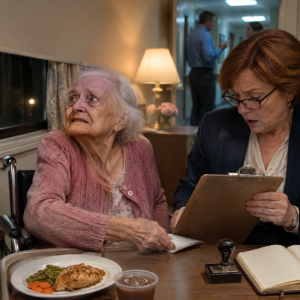
Last Sunday, Dad came to the table holding a glossy brochure from the dealership on Route 9. He dropped it right onto Mark’s plate, on top of the mashed potatoes.
“They’ve got financing,” he said. “Even for guys like you.”
My mother, Linda, closed her eyes. I pushed my chair back, ready to say what I should have said years earlier.
Mark put his hand on my knee. He lifted the brochure off his plate, wiped the corner and set it aside. Then he folded his napkin into a neat square, the way he does when he’s deciding not to say something.
“I’m keeping the truck, Richard,” he said quietly. “It matters to me.”
“It’s scrap metal,” Dad snapped. “What could it possibly—”
The doorbell rang.
The man on the porch
Nobody visits my parents on Sunday evenings, so Dad answered the door with a frown. I followed, half to apologize to whoever it was for the shouting.
An old man stood on the porch. He was in his eighties, thin, in a pressed jacket and a navy-blue cap embroidered with USS Forrestal. A young woman in a college sweatshirt stood a step behind him, holding his elbow.
He wasn’t looking at us. He was looking past us at the driveway, at Mark’s truck, and his hand was shaking as he pointed.
“Is that the green Ford with the dent in the tailgate?” he asked. “Forgive me. I saw it at the hardware store yesterday and asked the clerk whose it was. He said it was a fellow named Mark who eats here on Sundays.”
Dad’s frown deepened. “What’s this about?”
The old man took off his cap.
“Son,” he said, looking over my father’s shoulder at Mark, who had come into the hallway, “I’ve been looking for that truck for twenty years.”
The night of the flood
His name was Walter Briggs. He sat on the edge of my mother’s good armchair as if he wasn’t sure he was allowed, and the young woman, his granddaughter Hope, sat on the arm beside him.
“April 2006,” he said. “The night the Miller Creek bridge flooded. You’ll remember, Richard. It was all over the news.”
Dad nodded slowly. Everyone in town remembered that night.
“My wife, Ruth, was driving home from her sister’s with our granddaughter in the back seat. Hope was eight months old.” His voice caught. “The water came over the road faster than anyone thought it could. The car stalled, and then it started moving.”
Hope squeezed his shoulder.
“A young man in a green pickup was coming the other way. He saw the headlights in the water, backed his truck to the edge, wrapped a tow chain around his own hitch and waded in up to his chest to hook it onto Ruth’s bumper. He pulled that car out with my wife and my granddaughter inside it. The chain snapped back when it came free and slammed into his tailgate.”
Every head in the room turned to the window, to the dent.
“By the time the ambulance came, he was gone,” Walter said. “Ruth only remembered the green truck, the dent and that he was soaked and kept saying, ‘Just get the baby warm.’ I’ve looked at every green Ford in three counties for twenty years. I put an ad in the paper every April.”
He looked at Mark.
“Ruth passed in March. The last thing she asked me was whether I’d ever found him.”
What Mark never told anyone
I turned to my husband. He was standing by the bookshelf with his hands in his pockets, red to the ears.
“You were nineteen,” I said. It wasn’t a question. Mark had told me the truck was his late father’s, and that he’d driven it since he was a teenager. He’d never told me this.
“It was my dad’s truck,” Mark said softly. “He died that winter. I was driving home from his grave when I saw the lights in the water.” He shrugged, the way he does when he’s embarrassed. “I didn’t think. I just did it. When it was over, I was shaking so hard I couldn’t talk to anybody. So I went home.”
“Why didn’t you ever say anything?” I whispered.
“Because I didn’t do it so anyone would know.”
Hope stood up then. She had a white envelope in her hands, worn soft at the corners.
“My grandmother wrote this the week after the flood,” she said. “She kept it in her jewelry box for twenty years in case we ever found you.”
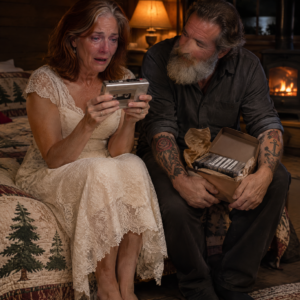
Mark opened it. His hands weren’t steady. He read it silently, then passed it to me.
To the young man in the green truck — I don’t know your name, but I pray for you every night. You gave my granddaughter her whole life. I hope someone, someday, tells you that you are the finest man I’ve ever met. — Ruth Briggs
Hope was twenty now, studying to be a pediatric nurse. “I wanted to be the person who pulls people out,” she said, and laughed through her tears.
My father’s silence
Through all of this, my father hadn’t said a word.
He was still holding the dealership brochure. I watched him look down at it as if he didn’t know how it had gotten into his hand. Then he crumpled it, slowly, until it was a small hard ball.
He walked out the front door. Through the window we watched him go down the driveway and stand by the truck. He ran his palm over the dent in the tailgate, the way you’d touch a scar on someone you love.
When he came back in, his eyes were wet. In thirty-four years I’d seen my father cry once, at his own mother’s funeral.
He held out his hand to Mark.
“I’ve said a lot of things at that table,” he said, his voice rough. “Every one of them was wrong. I’m sorry, son.”
It was the first time he’d ever called Mark son.
What changed after that Sunday
Walter and Hope stayed for dinner. My mother reheated the pot roast, and Dad set two extra places himself, which he had never done in his life.
Walter now comes every Sunday. He and Dad argue about baseball like they’ve known each other for fifty years. Hope sends Mark a text every April, on the anniversary of the flood: Still here. Thank you.
As for the truck, it still has the dent. Last month Dad offered to pay to have the tailgate fixed. Mark thought about it and said no.
“That dent’s the best thing about it,” he said.
Dad nodded. “Yeah,” he said. “I suppose it is.”
Last Sunday, when we pulled into the driveway, my father was standing on the porch. He waved at the truck, not at us. When Mark got out, Dad said:
“Good-looking pickup you’ve got there.”
This story is a work of fiction. Names, characters and events are invented, and any resemblance to real people is coincidental.