My brother laughed when Dad left me only a rusty toolbox. Three weeks later, I found what Dad had hidden inside for me.
My father’s will was read on a gray Thursday afternoon, in a lawyer’s office that smelled like burnt coffee and lemon furniture polish. My brother Glen sat in the leather chair closest to the desk, legs crossed, already checking his phone before the lawyer had finished the first page.
I sat by the window and held my purse in my lap like it might keep me steady.
The house went to Glen. So did Dad’s pickup truck and what was left in his savings account. The lawyer read it all in the same flat voice, and Glen nodded along as if he were hearing a weather report he’d already seen.
Then the lawyer turned to me.
“And to his daughter, Marianne, he leaves his wooden toolbox, along with its contents.”
That was it. That was my line.
Glen let out a short laugh. “He knew you’d never fix anything anyway,” he said, loud enough for the secretary outside to hear.
I didn’t answer. I couldn’t. I just stared at the rain sliding down the window glass and tried to remember how to breathe.
The Sundays Nobody Counted
For the last six years of his life, I drove to Dad’s house every Sunday. It was forty minutes each way, and I never once missed a week, not even the winter I had the flu and showed up with a box of tissues and a thermos of chicken soup.
I picked up his prescriptions. I sorted his mail. I learned how to bleed the radiators because he could no longer kneel on the floor. When his hands got too shaky to button his shirts, I bought him a few with snaps and never said a word about why.
Most Sundays we did nothing special. We watched old westerns. We ate grilled cheese sandwiches. He told me the same stories about his years at the lumber yard, and I laughed at the same parts every time, because he liked it when I laughed.
Glen lived twelve minutes away.
He came by, too. Just not on Sundays, and not often. He came when his car needed new tires. He came the month his boat payment was late. He came, once, to ask if Dad would “co-sign something small,” which turned out not to be small at all.
Dad always said yes. He never complained to me about it. But I saw his face after Glen’s truck pulled out of the driveway, and I knew.
So when the will gave nearly everything to Glen, it didn’t just sting. It felt like those six years of Sundays had been quietly erased.
The Toolbox by the Door
The toolbox was heavy, dark pine with brass corners worn smooth from use. Dad built it himself the year I was born. I remember sitting on the garage floor as a little girl, handing him screws one at a time while he hummed songs off the radio.
Glen dropped it off at my house the following weekend. He didn’t come in. He set it on the porch, knocked twice, and was backing out of the driveway before I even reached the door.
I dragged it inside and left it by the front door. I couldn’t look at it without feeling angry, and I hated feeling angry at a dead man I loved.
One evening, a few days later, I picked it up and carried it all the way to the curb. Trash day was the next morning. I stood there in my slippers with the streetlight buzzing overhead, telling myself it was just a box of old metal and I didn’t need it.
Then I thought about his hands. The way they’d shaped those brass corners. The way they’d shaken, near the end, when he tried to hold a coffee cup.
I carried it back inside.
What Was Taped to the Bottom
It took me three more weeks to open it.
It was a Sunday, of course. The first Sunday I had nowhere to drive. I woke up early out of habit, made two cups of coffee before I remembered I only needed one, and sat down on the living room rug with the toolbox in front of me.
The top tray held exactly what you’d expect: screwdrivers with cracked handles, a tape measure, a jar of mismatched nails. Underneath it were the wrenches, heavy and rusty and smelling like his garage.
I lifted them out one by one and set them on a towel.
That’s when I saw it. A thick manila envelope, taped flat against the bottom of the box with layers of yellowed packing tape. It had clearly been there a while.
On the front, in Dad’s shaky handwriting, were two words: For Marianne.
My hands were trembling as badly as his used to.
The Deed and the Note
Inside the envelope was a folded legal document and a single sheet of lined notebook paper.
The document was a property deed, a small cabin and two acres on a lake about an hour north of town. The deed was already in my name. It had been transferred to me almost three years earlier. Dad had arranged it quietly, while he was still well enough to sign, so that it never had to pass through the will at all.
I didn’t even know he owned a cabin.
Then I unfolded the note.
He wrote that he’d bought the place decades ago, when Mom was still alive, and that they used to sneak away there before Glen and I were born. After she passed, he couldn’t bring himself to go back, but he couldn’t sell it either.
He wrote that he knew Glen would get the house and that it would make Glen happy for a while, because Glen always needed something to show people.
And then, at the bottom, he wrote the line I still carry in my wallet:
“You came every Sunday. He came when he needed money. This one’s yours, kiddo.”
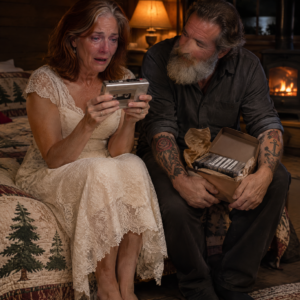
I sat on that rug and cried until my coffee went cold.
Why He Did It This Way
For a while I wondered why Dad hid it. Why not just tell me? Why let me sit in that lawyer’s office and feel like I’d been forgotten?
I think I understand now.
If he had put the cabin in the will, Glen would have fought for it. There would have been calls, arguments and probably lawyers. Dad knew his son. He knew that anything left out in the open would become one more thing to fight over.
So he hid it in the one place Glen would never bother to look: a box of rusty tools Glen had just finished laughing at.
Dad always said the best way to protect something valuable was to make it look ordinary.
The First Sunday at the Lake
I drove up to the cabin the following weekend.
The road was gravel, and the last half mile was more potholes than road. The cabin was small, with a sagging porch and a screen door that hung crooked on one hinge. Pine needles covered the roof. The windows hadn’t been washed in years.
It was perfect.
Inside, on a shelf above the woodstove, there was a framed photo of my parents. They were young, sunburned and laughing, sitting on that same porch with fishing poles across their knees.
I’ve spent most of my Sundays there since then. I fixed the screen door. I replaced two boards on the porch. I bled the old pipes the way Dad taught me.
Turns out Glen was wrong. I can fix things just fine.
What About Glen?
Glen sold the house eight months later. I heard most of the money went to pay off debts he’d never mentioned to anyone.
He doesn’t know about the cabin. Maybe someday I’ll tell him. Maybe I’ll invite him up to sit on the porch and look at the photo of our parents and remember that we used to be a family before money got in the way.
But not yet.
For now, every Sunday, I drive north instead of south. I make one cup of coffee. I sit on the porch my father built his happiest memories on.
And I keep his toolbox by the door, right where it belongs.
This story is a work of fiction. Names, characters and events are invented, and any resemblance to real people is coincidental.