My family feared the quiet, tattooed man I married. On our wedding night, a shoebox of old cassette tapes revealed his secret.
The night I met Hank, my car wouldn’t start and I had a funeral order wilting in the back seat.
It was a Tuesday in February, a little before seven. I’d owned Rhonda’s Blooms on Main Street for eleven years, and I’d never had a week like that one. The cooler had broken on Monday. A bride had cancelled on Wednesday. Now forty-two white carnations needed to reach a church by nine the next morning, and my car was making a sound like a sad cough.
The tow truck that came was older than my daughter. The man who climbed out of it was tall and broad-shouldered, with a gray beard down to his collarbone and tattoos from his wrists up under his rolled sleeves. Roses, an anchor, a skull with a pocket watch in its teeth.
He glanced at the flowers. “Somebody’s having a worse week than you.”
“Not by much.”
He didn’t tow the car. He jumped it, checked the battery terminals, tightened something under the hood, and told me I was good. When I pulled out my wallet, he shook his head. So I gave him a carnation. He tucked it behind his ear like it was the most natural thing in the world, and drove off.
Two weeks later he walked into my shop and bought one carnation. Then he asked if I’d let him buy me dinner.
The Man My Family Didn’t See
I had been a widow for six years. My husband, Dale, died of a heart attack in our backyard while hanging a bird feeder. After that I stopped expecting anything for myself. I had the shop, my two grown kids, my granddaughter Lily, and my mother June, who lived two hours away at an assisted living home called Maple Grove.
Hank was 56, a mechanic who owned a small repair garage and drove the tow truck at night. He’d been married once, a long time ago. He didn’t talk much about it, and I didn’t push.
What he did talk about surprised me. Old country records. The best way to grow tomatoes. The year he spent rebuilding a 1964 pickup piece by piece. He listened when I talked, too, really listened, which I hadn’t felt in a long time.
My kids saw something else.
“Mom,” Kayla said after their first dinner together, “he barely said ten words. And the skull, really?”
“The skull is from when he was nineteen.”
“That’s not the point.”
Travis was the one who worried me. He’s like his father: slow to speak, slower to forgive.
“Every other Saturday he’s gone,” he said one evening, drying dishes in my kitchen. “Seven in the morning till dinner. You don’t know where. Doesn’t that bother you?”
It did. I’d asked Hank once, gently. He’d looked at me for a long moment and said, “Somewhere I promised to be. I’ll tell you when it’s time. I need you to trust me on that.”
I told myself I did. Most days, I did.
The Saturday Problem
The truth is, the Saturdays crept into everything.
Kayla started making little comments. “Is it his Saturday this week?” Travis stopped coming to Sunday dinner when Hank was there. Once I found myself driving past his garage at eight in the morning just to see if the truck was gone. It was. I felt sick and ashamed in equal parts.
What made it harder was that Hank kept proving my kids wrong in every other way.
He fixed the dripping faucet in my upstairs bathroom at midnight because I’d mentioned it kept me awake. He learned that I take my coffee with cream and half a sugar, and never once asked again. When my granddaughter Lily had her spring dance recital, three hours in a hot middle school gym, Hank sat beside me through all of it and clapped louder than any father in the room.
The spring after we met, I took him to Maple Grove for my mother’s 80th birthday. Mom had good days and foggy ones by then. That afternoon she was sharp as a tack. She took one look at Hank’s arms and said, “Well. You’re not boring.”
They talked for an hour about her old Buick. When I came back from finding the cake knife, she was holding his hand and he was nodding very seriously.
“What was that about?” I asked in the car.
“She’s a good woman,” was all he said.
Two years after the carnation, Hank proposed in the shop after closing, on one knee between the buckets of tulips. I said yes before he finished.
The Wedding and the Shoebox
We married on a cool Saturday in October on the shore of Lake Harmon, with about thirty people and a borrowed speaker playing the old country songs Hank loved. Mom wasn’t well enough to make the drive, and that broke my heart a little. Kayla came and even cried during the vows. Travis sat in the very last row and slipped out before the cake.
That night we drove to a little rented cabin on the far side of the lake. It had a wood stove, a quilt that smelled like cedar, and a window looking out over black water.
I kicked off my shoes and laughed. “We really did it.”
Hank didn’t laugh. He went to his duffel bag and came back with a shoebox wrapped in plain brown paper. He sat down on the edge of the bed, set it on his knees, and for a while he just looked at it.
“Rhonda,” he finally said, “it’s time I told you where I’ve been going.”
My hands went cold. Every one of Travis’s questions came rushing back at once.
He lifted the lid. Inside was a cheap silver cassette recorder, the kind I hadn’t seen since the eighties, and a stack of tapes held together with a rubber band. Each one had a strip of masking tape on it, labeled in a slanted, shaky hand.
Rhonda’s first year. Your daddy and the fishing boat. Grandma’s peach pie. The winter the pipes froze.
My mother’s handwriting.
“Before you press play,” he said, “you should know she made me swear not to tell you.”
What Mom Asked For
He told me everything, slowly, the way he does.
On her 80th birthday, when I’d gone looking for the cake knife, my mother had grabbed his hand and whispered that she was scared. Not of dying. Of forgetting. Her doctor had told her the foggy days would come more often. She’d been trying to write things down for me, the stories of my childhood, my father, her own mother’s recipes, but her hands shook too badly.
“She asked if I could bring her a tape recorder,” Hank said. “And if I could keep coming back so she had someone to talk to while she made them. She didn’t want you to know. She said you’d worry, and you’d try to come every week, and the shop would suffer. She wanted it to be a wedding present. She was sure there’d be a wedding.”
So every other Saturday for almost two years, Hank had driven two hours to Maple Grove. He’d sat with her in the sunroom while she talked into that little recorder. On her foggy days, he’d just play cards with her or read her the newspaper. On her clear days, she told stories for hours.
The staff called him “June’s Saturday fella.” My mother had made them promise to keep quiet, too.
I pressed play on the first tape.
My mother’s voice filled the cabin, younger-sounding than I’d heard it in years. She was telling the story of the night I was born in a snowstorm, and how my father had driven the car into a ditch and carried her the last quarter mile to the hospital.
I don’t know how long I cried. Hank just held me.
The last tape in the stack was labeled Open last. On it, after a long pause, Mom said: “Rhonda, honey, if you’re hearing this, you married the one who showed up. That’s the only kind worth having.”
The Sunday Dinner
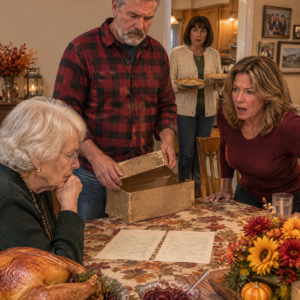
At Thanksgiving, I set the recorder in the middle of the table and played the tape about my father and the fishing boat. Travis had never heard it. He was named after the grandfather in that story.
When it ended, nobody said anything. Then Travis got up, walked around the table, and held out his hand to Hank.
“I thought you were hiding something bad,” he said, his voice rough. “I’m sorry.”
Hank shook it. “You were looking out for your mother. I’d have done the same.”
Kayla hugged him so hard he nearly spilled his coffee.
Mom passed peacefully that following spring. I had been visiting her every Saturday by then, and Hank came with me every time. Some days she knew us, some days she didn’t, but she always smiled at the man with the drawings on his arms.
I have eleven tapes now. I’ve copied them three times so they’ll never be lost, one set for me, one for Kayla and one for Travis.
People judge a man by what’s on his skin. I almost let them. What I learned is that the people who love you best don’t always explain themselves right away. Sometimes they’re too busy keeping a promise.
This story is a work of fiction. Names, characters and events are invented, and any resemblance to real people is coincidental. Images are for illustration only.