A rural mail carrier found a frightening crayon drawing in a mailbox. What she discovered inside the farmhouse changed three lives.
I have delivered mail on Rural Route 9 for twenty-two years. In that time I’ve learned which dogs bite, which bridges ice over first, and which porches have someone waiting by the window for a letter that never seems to come.
My name is Marlene. I’m sixty-one, and I thought I’d seen just about everything a mailbox could hold.
I was wrong.
The Boy Who Didn’t Talk
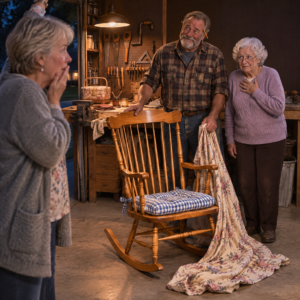
The last house on County Road 14 is a white farmhouse with a sagging porch and a red mailbox shaped like a little barn. For years it belonged to Earl, a widower who’d wave at me with two fingers from his recliner and never once complained about anything.
Last spring, a boy appeared on that porch.
Earl explained it one afternoon while signing for a package. His daughter was going through a hard stretch out of state, and his grandson, Wyatt, had come to live with him “for now.” Earl didn’t say how long “for now” might be, and I didn’t ask.
Wyatt was nine, skinny, with a cowlick that never lay flat. He didn’t speak. Not a hello, not a thank you, nothing.
“He’s never been a talker,” Earl told me. “Doctors have a name for it. But he talks with his pencil. Always has.”
A week later, I found out what he meant.
The red flag on the mailbox was up, even though Earl almost never sent anything. Inside was a sheet of paper folded in half. On the front, in big careful capitals: MISS MARLENE.
It was a drawing of my mail truck, complete with the dent in the bumper I’d gotten from a deer two winters before.
I laughed out loud, alone in the truck.
Gold Stars and Cows in Sunglasses
After that, there was a drawing every single morning.
A tractor. A thunderstorm with a smiling sun peeking out behind it. Earl asleep in his recliner with a newspaper over his face. A cow wearing sunglasses, which I still keep on my refrigerator.
I started leaving something back. I bought a roll of stickers at the dollar store — gold stars, dinosaurs, little American flags — and stuck one on an index card every afternoon.
When I drove past the next day, Wyatt would be on the porch, holding the card up high so I could see he’d gotten it, grinning ear to ear.
It became the best two minutes of my route. Honestly, some days it was the best two minutes of my week. My own kids are grown and live a long way off, and I hadn’t realized how much I missed being somebody’s small, ordinary routine.
That went on for eight months.
The Drawing That Changed Everything
The Monday it happened was cold, the kind of October morning where the frost still clings to the fence posts at nine o’clock.
I pulled up at 9:40. The flag was up, like always. I smiled before I even opened the box.
The drawing inside wasn’t a tractor.
It was a kitchen. I could tell from the checkered floor and the stove in the corner. A man lay flat across the tiles. His eyes were two short lines. Next to him, a small boy was holding out a blanket. In the corner of the page was a telephone with a thick black X scribbled through it, pressed so hard the crayon had torn the paper.
Underneath, in letters much shakier than usual, it said: 3 DAYS.
I turned the page over. On the back he had drawn it again. And again, smaller, along the bottom edge. As if he’d been afraid I wouldn’t understand the first time.
I dropped the rest of the mail in the gravel and didn’t even bother picking it up.
Earl’s truck sat in the driveway where it always did. The porch light was on, glowing weakly in broad daylight. I realized then that I hadn’t seen Wyatt on the porch on Saturday. I’d assumed they’d gone into town.
I knocked. Nothing.
I knocked harder. “Earl? It’s Marlene. Your mail lady.”
The knob turned slowly, and the door opened a few inches.
Wyatt stood there in thin cartoon pajamas, barefoot on a cold floor, holding a half-empty sleeve of saltine crackers. His eyes were red and enormous.
He didn’t make a sound. He just took my hand and pulled.
What Was on the Kitchen Floor
Earl was lying exactly where the drawing said he would be, between the table and the stove.
He was awake, barely. His face was gray, and his lips were dry and cracked. Someone had tucked a pillow under his head and piled every blanket in the house over him — the afghan from the couch, two bath towels, Wyatt’s own dinosaur comforter.
Next to his hand was a glass of water with a bendy straw, and a neat little row of crackers on a paper towel.
“Marlene,” Earl whispered. “Hip. Saturday night. Couldn’t get up.”
I was already dialing 911 on my cell phone. The house phone hung on the wall, but the line was dead — I found out later a storm had knocked it out the week before, and Earl had been meaning to call the company about it. He didn’t own a cell phone. He’d always said he didn’t need one.
While we waited for the ambulance, I knelt on that cold floor and held Earl’s hand, and Wyatt sat pressed against my side.
In bits and pieces, Earl told me what happened. He’d slipped getting a glass of milk late Saturday night and heard something crack. He couldn’t stand, couldn’t crawl more than a few feet, and couldn’t reach anything useful.
For almost three days, a nine-year-old boy who couldn’t speak had taken care of his grandfather all by himself.
He’d brought water every few hours. He’d fed him crackers and applesauce. He’d covered him with everything warm he could find when the house got cold at night. He’d tried the dead phone over and over.
The nearest neighbor was more than a mile away, down a dark county road. Wyatt was too scared to leave his grandpa alone, and he didn’t have the words to ask a stranger for help even if he’d found one.
But he knew one person would come to that mailbox, every single day, no matter what.
So on Saturday, when the mail didn’t come, he waited. On Sunday, when the mail didn’t come, he waited. And early Monday morning, he drew the most important picture of his life, raised the red flag, and trusted me to read it.
The Doctor’s Words
The paramedics were there in eighteen minutes. They said Earl was severely dehydrated and had a fractured hip, and that he was lucky someone had kept giving him fluids.
At the hospital that afternoon, the emergency room doctor pulled me aside in the hallway.
“If he’d been on that floor without water for three days,” she said quietly, “we’d be having a very different conversation. That boy kept him alive.”
I went back into the room and found Wyatt curled up in the chair beside Earl’s bed, asleep at last, still in his pajamas. A nurse had found him a pair of hospital socks.
I sat down beside him and cried harder than I had in years.
What Happened Next
Earl had surgery on Tuesday. It went well, but he needed weeks in a rehab center, and Wyatt needed somewhere to stay.
The social worker was kind and careful. She asked a lot of questions, called Wyatt’s mother, and spoke with Earl at length. In the end, with everyone’s agreement and the proper paperwork signed, Wyatt stayed with my husband, Ron, and me in our spare room until his grandpa came home.
He left a drawing on my kitchen table every morning. The first one showed the hospital, with a big gold star on the roof.
Word got around the way it does in small towns. When Earl came home in December, his porch had a new handrail, built by the men from his church. The phone company had fixed the line, and someone had quietly paid for a basic cell phone for him, with my number already saved as the first contact.
The postmaster even put a letter of commendation in my file, which embarrassed me more than anything. I hadn’t done anything special. I’d just read my mail.
Wyatt is the one who did something special.
The Lesson in the Mailbox
Earl and I sit on his porch some afternoons now, once my route is finished. Wyatt has started working with a speech therapist twice a week, and he uses a tablet to type words when his pencil isn’t fast enough. His mother calls every Sunday and is planning a long visit in the spring.
Earl asked me to be his emergency contact. I said yes before he finished the question.
“I always thought he was the one who needed looking after,” Earl told me once, watching Wyatt chase the barn cats across the yard. “Turns out it was the other way around.”
I still get a drawing every morning. Last week it was the two of us — Wyatt and me — standing next to my mail truck, holding hands, under a sun with sunglasses on.
I think about how close that Monday came to going differently. If I’d been running late. If I’d stopped checking his mailbox because it was “just a kid’s drawing.” If I hadn’t bothered to turn the page over.
The people who need help most aren’t always the ones who can ask for it out loud. Sometimes they’re counting on you to notice the small things — a porch light left on, a flag raised a little earlier than usual, a crayon pressed hard enough to tear the paper.
Pay attention. You never know who’s waiting at the end of your road.
This story is a work of fiction. Names, characters and events are invented, and any resemblance to real people is coincidental. Images are for illustration only.