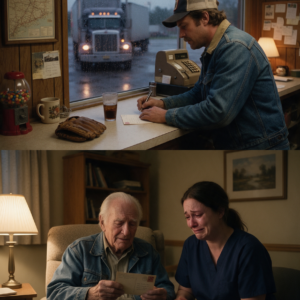
Every Thursday, my husband vanished into our widowed neighbor’s garage. When I finally pulled the door open, the truth stopped me cold.
The Neighbor Who Couldn’t Fix Anything
When you’ve lived on the same street for 34 years, you know everyone’s rhythms. I knew Hal across the street mowed his lawn every Saturday at nine. I knew his wife, Lorraine, liked her coffee on the porch at sunrise. And I knew that in their house, Hal handled every washer, wire and hinge.
So when Hal passed away last March, after a short illness nobody saw coming, I worried about Lorraine. She was 66, and she’d told me more than once that she didn’t know where the water shut-off valve was.
I’m Denise. I’m 61. My husband, Walt, is a retired high school shop teacher, the kind of man who keeps a pencil behind his ear even at Thanksgiving dinner. When Lorraine knocked on our door that first Saturday in April, holding her robe closed at the neck, she looked embarrassed.
“I hate to ask,” she said. “My kitchen faucet drips all night. I can’t sleep. Could Walt take a look?”
“Of course,” I told her. “That’s what neighbors are for.”
I meant it. I really did.
“Just One More Little Thing”
The faucet took Walt twenty minutes. He came home pleased with himself and told me Hal’s workshop in the garage was “a museum of good tools nobody’s using.”
The next Saturday, Lorraine called about her garbage disposal. The week after, a squeaky screen door. Then a loose porch step, a ceiling fan that wobbled, a closet door that wouldn’t latch.
By June, the phone rang nearly every evening. Walt always went.
I didn’t mind at first. But little things started to pile up. He’d come home after dark with sawdust in the hair on his forearms. His shirts smelled like lavender hand soap, Lorraine’s soap. Once he hummed a song I didn’t recognize and, when I asked what it was, said, “Oh, something Lorraine had on the radio.”
Then the Thursdays began.
Every Thursday at exactly 7 p.m., Walt picked up his old canvas tool bag, kissed my cheek, and said, “Lorraine’s garage door again.”
The first Thursday, I believed him. The second, I wondered how a garage door could break twice. By the fourth, I was standing at the kitchen window, watching the thin line of light under her garage door and counting the minutes until he came home. Usually around ten.
The Pound Cake and the Sticky Note
In July, our church held its summer potluck. Lorraine walked straight past me and handed Walt a thick slice of her lemon pound cake wrapped in a napkin.
“For all your hard work,” she said, squeezing his arm.
She didn’t bring me a slice. She barely looked at me.
On the drive home, I said, more sharply than I meant to, “She’s awfully grateful.”
Walt kept his eyes on the road. “She’s lonely, Denise. That’s all.”
That’s all. I lay awake that night repeating those two words.
I want to be clear: in forty years, Walt had never given me a single reason to doubt him. Not once. But grief does strange things to people, and loneliness does stranger ones. And I was 61, with reading glasses and a bad knee, and Lorraine had always been the pretty one on the street.
The fifth Thursday, I went out to water my hanging ferns and found Walt’s reading glasses on our porch swing. Stuck to the lens was a yellow sticky note in Lorraine’s looping handwriting:
“You left these. Don’t let her find out. — L.”
I read it three times. Then I sat down on the swing because my legs wouldn’t hold me.
Don’t let her find out.
There was only one “her” in that sentence, and it was me.
Lifting the Garage Door
I didn’t say anything when Walt came home for dinner. I served the pot roast. I asked about his day. At 6:58, he picked up the canvas bag.
“Garage door?” I asked.
“Garage door,” he said, and didn’t quite meet my eyes.
I waited forty minutes. I wanted to catch them, whatever “them” was. At 7:40, I put on my sneakers and walked across the street in the dark, the sticky note folded in my fist.
Light glowed under Lorraine’s garage door. I heard Walt’s low voice, then Lorraine laughing, a real laugh, the first I’d heard from her since the funeral. It hit me like a slap.
I grabbed the handle and heaved the door up with everything I had. It rattled on its tracks and banged open.
Walt and Lorraine spun around. They were standing on either side of something tall, draped in an old flowered bedsheet. Hal’s workbench was covered in sandpaper, rags, little cans of stain and a sewing basket.
Lorraine’s face went white.
“Denise,” she whispered. “You weren’t supposed to see this until Sunday.”
“See what?” My voice cracked. “What exactly wasn’t I supposed to see, Lorraine?”
Walt set down his sanding block. He looked at me for a long moment, and his face wasn’t guilty. It was disappointed, in the way of a man whose surprise had just been ruined.
“Well,” he said quietly. “I guess you’d better see it now.”
He pulled the sheet away.
My Mother’s Rocking Chair
It was a rocking chair. Maple, with a high spindle back and arms worn smooth.
I knew that chair. I knew it the way you know your own handwriting.
It was my mother’s. She rocked me in it. She rocked my brothers in it. She sat in it on her porch in Kentucky every evening until she was 89. When we cleaned out her house eleven years ago, the chair was cracked through the seat, one rocker split, the finish black with age. The movers said it wasn’t worth hauling. I cried in the driveway, and then I let it go.
“You threw it out,” I said. “I watched them put it by the curb.”
“You watched them put it by the curb,” Walt said. “I went back for it that night after you fell asleep in the motel. It’s been in the back of our storage unit ever since. I always meant to fix it. I just never had the tools, or the nerve.”
He nodded toward the workbench. “Hal had the tools. A steam box for bending wood. Clamps I’d only seen in catalogs.”
Lorraine stepped forward, twisting a rag in her hands. “And I used to reupholster furniture for a shop downtown, before I married Hal. Walt asked if I could make a cushion like the one in your old photo.” She pointed to the seat. There, tied on with ribbons, was a cushion in faded blue gingham, almost exactly like the one in the photograph on our hallway wall of my mother holding me as a baby.
“Your anniversary is Sunday,” Lorraine said. “Forty years. He wanted it on your porch when you woke up.”
I looked at the sticky note in my hand. Don’t let her find out.
Then I started to cry, and I couldn’t stop.
What I Owed Lorraine
Walt held me in that garage for a long time. Lorraine quietly put the kettle on in her kitchen.
When I finally could talk, I told them the truth: what I’d thought, what I’d counted at the window, how I’d felt about the pound cake. I was ashamed saying it out loud. Walt just squeezed my hand.
Lorraine set a cup of tea in front of me and sat down across her little kitchen table.
“I didn’t bring you cake at the potluck,” she said, “because I was afraid I’d blurt out the whole thing if I talked to you. I’m a terrible liar. Hal always said so.” Her eyes filled. “And honestly, Denise, those Thursdays saved me. Hearing someone working in that garage again, the radio on, the smell of the stain. It felt like the house was breathing again.”
I realized then that all those dripping faucets and wobbling fans hadn’t been excuses to get my husband alone. They’d been excuses not to be alone. And instead of seeing a grieving woman, I’d seen a threat.
“I’m so sorry,” I told her. “I should have been over here every week myself.”
Sunday Morning on the Porch
On Sunday, I pretended to be surprised anyway. I came out at seven with my coffee, and there it was on our porch, my mother’s chair, golden and whole, the gingham cushion tied on just right. Walt had tucked a card under the ribbon: “Forty years, and I’d still go back to the curb for you.”
I sat down and rocked, and for a moment I was four years old in Kentucky with my mother’s arm around me.
Then I walked across the street and knocked on Lorraine’s door.
“Coffee on my porch,” I said. “Every Sunday, from now on. And Thursdays, you’re both coming to my kitchen. I want to learn how to use that steam box.”
She laughed, that real laugh again.
We’ve kept that promise for months now. Lorraine taught me to recane a chair seat. Walt taught her where the water shut-off valve is. And I learned something I should have known at 61: sometimes what looks like betrayal is simply love working quietly in another room, waiting for the right moment to show itself.
This story is a work of fiction. Names, characters and events are invented, and any resemblance to real people is coincidental. Images are for illustration only.