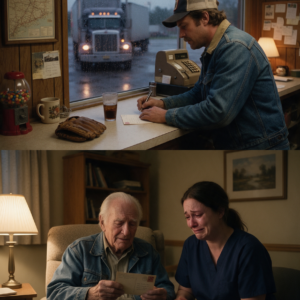
A notary is called to a nursing home at 9 p.m. for a rushed signature. An 84-year-old’s six-word napkin note changes everything.
A Son Rushed His Mother to Sign Papers at Night. Then She Slipped the Notary a Napkin.
People think notaries just stamp things. We do stamp things. But the real job is making sure the person signing knows what they’re signing and wants to sign it.
My name is Loretta. I’m 56, and I’ve been a mobile notary for eleven years. I bring my stamp, my journal and a pen that actually works to hospitals, kitchen tables and truck stops.
I’ve seen people sign happy papers and sad ones. Before that Tuesday in March, I had never been handed a secret.
The Call That Paid Double
The phone rang at 7:15 p.m. while I was rinsing my dinner plate.
“I need a power of attorney notarized tonight,” a man said. “My mother’s at Maple Hollow Care Center. She’s sharpest in the evenings. I’ll pay you $150.”
My usual fee is $75. When someone offers double without being asked, it’s usually either kindness or hurry.
His name was Curtis. He sounded pleasant and organized, and he spelled his mother’s name for me twice: Irene Haskell.
I got there at 8:35. The lobby smelled like lemon floor cleaner and mashed potatoes. Curtis was waiting by the front desk in a pressed blue shirt and loafers so new the soles hadn’t creased. He shook my hand, thanked me three times, and walked me down the hall faster than I like to walk.
A Woman Who Offered Me Her Pudding
Irene was sitting by her window in a pink cardigan with the buttons done up one off. She had a dinner tray in front of her: chicken, green beans, a cup of chocolate pudding. None of it had been touched.
“Mom, this is the lady I told you about!” Curtis said, loudly and slowly, the way people talk to someone they’ve decided can’t keep up.
Irene looked at me for a long moment, then smiled. “Would you like my pudding, honey? They give it to me every night.”
I sat down beside her. I always talk to the signer before anything gets signed. I asked her full name. She gave it, including a middle name, Margaret. I asked the date. She said Tuesday, March the eleventh, which was correct.
Then I asked her what she was signing tonight.
Her eyes moved to her son before they came back to me. “It helps my son take care of the house.”
“Close enough,” Curtis said with a laugh. “Can we get moving? Visiting hours end at nine.”
The document was twelve pages long. Curtis had marked every signature line with a little yellow tab, as if he’d done it many times in his head. I flipped through it. This wasn’t a simple medical power of attorney. It gave him broad control of her finances, including the power to sell her real estate, effective immediately.
A nurse leaned in the doorway. “Mr. Haskell, can I see you a second? It’s about the visitor log.”
Curtis sighed and stepped into the hall.
That was when Irene reached across the tray table as if to straighten my papers. Her fingers were cold and thin. She slid a folded paper napkin under my clipboard and pressed down on it twice with two fingers.
She didn’t look at me. She looked out the window at the dark parking lot.
Six Words in Blue Ink
Curtis came back in. “All set?”
“One minute,” I said. “I need to check my stamp.”
I unfolded the napkin below the edge of the table.
Please don’t. He’s lying. Call Joanne.
The ink was blue and shaky. She had pressed so hard that the pen had torn the napkin in two places. It must have taken her a long time to write.
I folded it, put it in my blazer pocket, and closed my journal.
“Mr. Haskell,” I said, “I need to speak with your mother alone for a few minutes. That’s standard when a document is this broad.”
His smile tightened. “She gets confused when I’m not here.”
“Then it’ll only take a few minutes.”
He didn’t move. The nurse, whose badge said Denise, was still in the doorway. “There’s coffee in the family lounge,” she told him. Her tone made it clear it wasn’t an offer.
He went.
“Who Is Joanne?”
Once the door clicked shut, Irene’s shoulders dropped about two inches.
“Joanne is my daughter,” she said quietly. “Curtis tells me she doesn’t want to see me anymore. He says she’s angry about her father’s funeral. But Joanne wrote me every week for thirty years. Then the letters just stopped. The same month Curtis started bringing me my mail.”
She told me about the house on Larkspur Street where she’d raised both children and where her husband had built the back porch by hand. Curtis had said the papers were “just so the roof gets fixed.” But last week she had heard him on the phone in this room, telling someone the sale could close by Friday “once Mom signs.”
“I’m old,” Irene said. “I’m not stupid. I just didn’t know who would believe me.”
I told her I believed her.
Then I did the only thing my job allowed me to do. I wrote in my journal that the signer could not explain the document and had indicated she did not wish to sign it, and I refused the notarization.
When Curtis came back and I told him, the pleasant voice was gone.
“You’re throwing away a hundred and fifty dollars over a confused old woman,” he said.
“I haven’t taken your money,” I said. “And she isn’t confused.”
He leaned closer. “If you’re thinking about calling my sister, don’t bother. Joanne is dead to this family.”
Behind him, Denise was quietly writing something on her clipboard.
The Phone Call at 11:02
I sat in my car in the parking lot for twenty minutes with my hands shaking on the steering wheel. Notaries don’t call people’s relatives. We aren’t detectives. But I couldn’t drive away.
I went back inside and found Denise at the nurses’ station. I showed her the napkin.
She read it twice and let out a long breath. “Six weeks ago, Mr. Haskell had us take his sister off the emergency contact list. He said she was abusive and his mother was afraid of her. I didn’t like it then.” She pulled up the old file. Joanne’s number was still in the notes.
Denise made the call herself, because that was proper. I left my card in case the family needed a witness to what I’d seen.
At 11:02 that night, my phone rang. The woman on the other end was crying so hard I could barely understand her.
It was Joanne. She lived four hours away in Indiana. Curtis had told her their mother had advanced dementia and became agitated at the sound of Joanne’s name. He told her the doctors recommended “no contact for her peace of mind.” He had been returning Joanne’s letters unopened, with “refused” written on them in handwriting that looked a lot like their mother’s.
“I’ve been grieving her,” Joanne said. “And she’s been sitting there thinking I gave up on her.”
She was in the parking lot at Maple Hollow by six the next morning.
What the Rush Was Really About
The truth came out over the next two weeks.
Curtis’s landscaping business had folded the previous summer. He had borrowed against everything he owned and hidden it from his wife. A buyer had made a cash offer on the Larkspur Street house, but only if the deal closed fast. Without a signed power of attorney, Curtis couldn’t sell it.
That was why it had to be that night. That was why he had offered double.
Joanne contacted Irene’s doctor, who did a proper evaluation. Irene had some memory trouble, the kind a lot of 84-year-olds have. But she understood her finances, her house and her family perfectly well. The facility filed a report with Adult Protective Services. The buyer backed out once lawyers started calling.
Curtis stopped visiting. I’m told he hasn’t called since.
A Signature in Daylight
Three weeks later, I went back to Maple Hollow at ten in the morning, with sun pouring through Irene’s window.
Irene was wearing the same pink cardigan, buttoned correctly this time. Joanne sat beside her, holding her hand. An attorney had gone through every page of a new document with her, slowly, twice. This one named Joanne as her agent, and Irene chose every word of it.
When I asked what she was signing, she answered before I finished the question.
“I’m making sure my house stays mine until I decide otherwise. And I’m making sure my daughter is the one who looks after me.”
She signed her name, Irene Margaret Haskell, in that same shaky blue ink. I stamped it. Then she pushed her pudding cup across the table toward me.
“I told you they give it to me every night,” she said. “I’ve been saving this one for you.”
That May, Irene moved to a care home ten minutes from Joanne’s house in Indiana. A card came for me in June. Inside was a fresh paper napkin, folded in half. On it, in the same blue ink:
Thank you. Six words weren’t enough.
It’s pinned above my desk now. Whenever a client rushes me, or offers double, or answers for someone else in the room, I look at it.
The quietest person in the room is usually the one you most need to hear.
This story is a work of fiction. Names, characters and events are invented, and any resemblance to real people is coincidental. Images are for illustration only.