
Page 2
I didn’t give Walt the truck that day. He had enough to carry. I put it in my coat pocket, where it stayed through the X-rays, the paperwork, and the long drive home with my neighbor Linda, who had finally gotten through to me by phone.
It stayed on the kitchen windowsill for three weeks, between the African violet and the salt cellar shaped like a hen.
Walt came home on a Thursday, one arm in a sling, grumbling at every stair. For days he did what he always does when he’s hurting: he fixed things. A dripping faucet. A squeaky hinge. A drawer that hadn’t closed properly since 1998.
On the fourth morning, I set the little truck on the table in front of him, next to his coffee.
“A man left this for you at the hospital,” I said. “The one who pulled you out. He said to tell you the boy kept his promise.”
Walt didn’t say anything.
He picked it up with his good hand and turned it over, the way you turn over something you already know the weight of. His thumb found the worn spot on the roof, right where mine had found it. His face went pale, and then something moved behind it, something that had been waiting a very long time.
He sat down slowly, as if his knees had decided for him.
“Ruth,” he said, and his voice cracked in the middle. “Where did you say he was from?”
“He never said. Walt, who is he?”
My husband looked at the toy for so long that his coffee went cold.
The boy in the bus
“It was January,” Walt said finally. “1995. Before we had the house. I was thirty-three and ran the garage on Mill Street, remember? We kept an old school bus out back for parts.”
I remembered the bus. I remembered how he used to scrape frost off its windows every winter, though he never could say why.
“One morning I opened up and the bus door was cracked. There was a boy asleep on the back seat, wrapped in a coat three sizes too big. Nine years old, maybe. Thin as a fence post. He’d run away from a foster placement across town. He hadn’t eaten in two days, and he flinched when I switched on the lights.”
I sat down across from him.
“I didn’t call anyone right away, Ruth. I should have. But I sat on the step of that bus and I shared my thermos of soup with him. Your soup, the barley one. He ate the whole thing and asked me if I was going to hit him. I said no. He asked me why not.”
Walt’s jaw worked for a moment.
“I said, because somebody should have been kind to you a lot sooner than this.”
He turned the truck in his fingers. “This was mine from when I was small. I kept it in my toolbox for luck. The boy wouldn’t let go of it, the whole time we waited for the caseworker. At the end I told him to keep it. I said, ‘Hang on to it. One day when you’re big enough to help somebody, you help them, and then you bring it back and tell me about it.'”
He wiped his eyes with the heel of his hand. “I never saw him again. I never even learned his name. The agency wouldn’t say. I figured I’d done a small thing and that was the end of it. Thirty-one years, Ruth. I never thought about it, and he never forgot.”
I thought of the man in the waiting room, sitting straight-backed with his cap in his hands. I thought of him saying, I saw taillights under the water, and how he had left out everything that mattered. Somewhere between the toolbox and the creek road, a frightened boy had turned into a man who stops for taillights.
Finding Eli
It took Walt eleven days and eight phone calls. The tow company would only say they’d pass a message along. On the twelfth day, a battered gray pickup pulled into our driveway just after noon.
He stood by the truck for a long moment before he came to the door. Without the cap and the mud, he looked younger and more nervous. He carried a paper bag.
“My name is Eli,” he said, to my husband, not to me. “Eli Moreno. I don’t know if you remember me.”
Walt got up out of his chair, sling and all.
“I remember a boy who wanted to know if I was going to hit him,” he said. “I’m very glad to see he grew into this.”
I will not forget what happened next. A grown man, tough as barn wood, the kind who pulls strangers from freezing creeks, crossed my kitchen in three strides and put his forehead on my husband’s good shoulder. Walt held him with one arm. Neither of them said anything for what felt like a full minute.
In the paper bag was a jar of barley soup. Eli had tried to make it from memory. “I got it wrong,” he admitted. “I think it needs more salt.”
“It always needed more salt,” I said, and then the three of us were laughing and wiping our faces like fools.
He told us the rest over coffee. Foster homes until eighteen. A job sweeping a tow yard, then driving the wreckers, then owning one. A wife, a daughter named Grace who was seven now. And every winter, on cold nights, he’d taken the little truck out of his own toolbox and held it, thinking of a man in a garage who had asked for nothing.
“I carried it so long I started to feel like it was mine,” Eli said. “But I always knew what I’d promised. I just didn’t know whose life I’d have to save to keep my word.”
“You didn’t know it was me,” Walt said.
“Not until I saw your wallet in the ambulance. Your name on your license. Hartley. Then I knew.” He swallowed. “Mr. Hartley, I wasn’t going to say anything. I thought if you knew, you’d feel like you owed me. I only wanted to give it back and go.”
Walt shook his head slowly.
“You don’t owe a man for being decent,” he said. “I’ve spent thirty-one years thinking I only gave away a toy. It turns out I was planting something.”
He pressed the little truck back into Eli’s palm and closed his fingers around it.
“Keep it,” he said. “Give it to Grace one day. And when someone needs a hand, you’ll know what to tell them.”
The shelf in our hallway
It has been two years since that night. Walt’s collarbone healed, though he still complains about it when it rains. Eli and his family come for supper on the first Sunday of every month, and Grace has decided I am her second grandmother, which is the best job I have ever been given.
The truck lives on a shelf in Eli’s hallway now, beside a framed photograph of the four of us on our porch. Under it, in Walt’s careful block capitals, a small card reads: PASS IT ON.
I think about that night often. About how close the water came, and how easily it might have gone the other way. And I think about the man who stopped for taillights, not because he owed anyone anything, but because somebody had once stopped for him.
We never know which small kindness will outlast us. A bowl of soup. A borrowed coat. A toy truck in a toolbox. We hand them out like pocket change, never guessing that one day they might come home with interest, on a freezing night, with a knock at the door.
So be kind when it costs you nothing. Someone is keeping count, even if it isn’t you.
This is a work of fiction. Names, characters and events are imaginary.
Related Posts

When a Wedding Invite Comes With an Entry Fee: Is a Mandatory Cash Gift Ever Okay?
…according to an invitation note specifying that guests were expected to contribute at least $150 in cash to offset the catering bill. The demand instantly turned a…
What a Single Pink Cupcake Revealed About 48 Years of Unbroken Love
It was a gray, rain-soaked Tuesday morning when I ducked into the corner bakery just looking for a quick caffeine fix before work. The shop was warm…
The Scarf She Left Behind
The call came at 4:42 on a Tuesday. I remember the time because I was holding a cup of cold coffee and looking at the clock, wondering…
My Sister Vanished on the Morning of My Wedding – 8 Years Later, I Found Her on My Porch Holding My Son’s Hand
I pushed the door open, expecting to find her buried under the duvet, sleeping through her third alarm the way she always did. The bed was neatly…
What One Slice of Cake Taught Me About Love That Outlasts Everything
An older man came in, shaking the rain off a tweed jacket that had clearly seen better decades. He didn’t look at the menu. “One slice of…
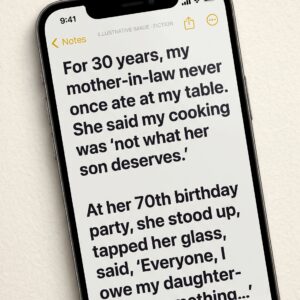
My Mother-in-Law Refused to Eat My Cooking for 30 Years — Then She Stood Up at Her Birthday Party
When I married Daniel, I was 26 and sure I could win over his mother. Margaret was a tall, silver-haired woman who ran her kitchen like a…