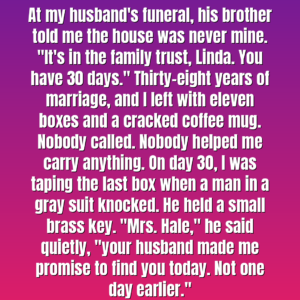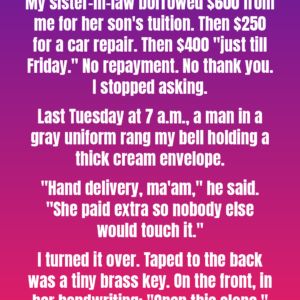
After her husband’s funeral, Ruth was locked out of her home of 31 years. Then a lawyer arrived with a brass key and a secret Tom had kept for eleven years.
Locked Out After 31 Years: The Brass Key Tom Left Behind
I never imagined I’d end up sleeping in a Buick outside a feed store at 54 years old, but that’s where I was the week the spring rain wouldn’t quit.
My name is Ruth Hale. My husband Tom died in March, after a short fight with his heart. We had been married for thirty-one years, and for all thirty-one we lived on his family’s farmhouse outside Millbrook, with its squeaky porch swing and the kitchen window that looked over the apple trees.
His sister Carol drove in from Columbus the day after he passed. She hugged me for exactly two seconds. By the time the funeral came, she had already taken over the program, the flowers and the seating.
When I walked toward the front pew, she stepped into my path.
“Family sits up here, Ruth,” she said, very softly, so only I could hear. “You can take the back.”
“I’m his wife,” I whispered.
“You’re not blood.”
I sat in the back row. Tom’s cousin Dale gave me a sad, helpless look, but nobody said a word. That’s how families like that work. Everyone sees the unkindness and everyone is waiting for someone else to stop it.
The Locks
Two weeks later I drove to the grocery store for milk and bread. When I came home, my key wouldn’t turn.
I tried it three times. Then I saw the new brass plate on the deadbolt, still shiny, and a note taped to the door in Carol’s slanted handwriting.
The property is part of the Hale family estate. I have spoken with an attorney. Please collect your personal belongings by appointment. — C.
By appointment. In a house where I had hung every curtain.
I called Carol and she didn’t answer. I called again and she sent me to voicemail. The third time, I got a text: Please don’t make this harder than it is.
I had one suitcase in the trunk from a visit to my sister’s the week before. I had a purse, a half-gallon of milk going warm on the seat, and $212 in checking.
I’m not proud of what I did next, which was nothing at all. For nine days I did nothing. I slept in the car in the parking lot of the feed store, where the owner, Mr. Abbott, pretended not to notice. I ate crackers and peanut butter from the gas station. When the rain was heavy, I paid $54 for a room at the Starlite Motel on Route 9, and I lay there staring at a water stain shaped like Florida.
I stopped answering my phone. My sister called eleven times. I couldn’t bear to tell her. If I said it out loud, it would be real: after thirty-one years, I was a woman with a suitcase.
The worst part wasn’t the house. It was the thought that maybe Carol was right. That maybe all those years I had only been a guest.
The Knock
On Friday morning, someone knocked on the door of Room 6.
I assumed it was the manager telling me my three nights were up. Instead, I opened the door and found an elderly man in a gray suit that had seen better decades. He was thin, with white hair combed carefully to one side, and he held a worn leather briefcase against his chest like a hymnal.
“Mrs. Ruth Hale?” he asked.
“Who’s asking?”
“My name is Walter Pruitt. I was your husband’s attorney. I’ve been looking for you for four days.” He glanced at the parking lot. “Your sister told me where to find you. She was quite worried.”
Then he opened his briefcase and took out two things: a small brass key, tarnished at the edges, and a yellowed envelope with my name on it in Tom’s careful block capitals.
“Tom came to my office eleven years ago,” Walter said. “He made me promise something. If his sister ever locked you out of the house, I was to bring you this. Not before. Not for any other reason.”
I stared at him. “Eleven years? Tom knew Carol would do this?”
Walter gave a sad little smile. “Mrs. Hale, your husband knew his sister very well.”
What Tom Knew
I sat on the edge of the motel bed and opened the envelope with shaking fingers. It was one page, written in blue ink.
Ruthie,
If Walter is handing you this, then Carol has done exactly what I was afraid she would do, and I’m sorry. I’m sorry I couldn’t stop it while I was here. You know how I was with her. I never could say no to my big sister, and that’s a failing you spent thirty-one years covering for.
But I wasn’t a complete coward. Eleven years ago, when Mama’s estate finally closed, I did something quietly. The farm was never going to be left to the family. I sold it. Not to a stranger. To you.
It’s all in the papers Walter has. The deed has been in your name since the spring of 2014. I couldn’t tell you, because you’d have fussed and said it wasn’t necessary. And I couldn’t tell Carol, because she’d have burned the whole thing down.
The brass key is for the cabinet in the barn, the one you always said was stuck. Open it when you’re ready.
You were never a guest, Ruthie. You were the whole reason it was a home.
Love, Tom
I read it three times. Then I put my hand over my mouth and cried until Walter politely pretended to study the wallpaper.
The Deed
Here is what Walter explained, in his slow, careful voice.
In 2014, Tom had quietly transferred the farmhouse and all forty acres to me for one dollar, which is perfectly legal. He had registered the deed with the county and then asked Walter to keep it in a sealed file, with strict instructions. The house I had lived in for three decades had belonged to me for eleven years.
Carol had no legal right to change a single lock.
“She told me she had consulted an attorney,” Walter said, and one corner of his mouth twitched. “I suspect she consulted someone who never checked the county records.”
I didn’t feel triumphant. I felt dizzy. All those nights in the car, and the whole time, the roof was mine.
The Cabinet
Walter drove me out to the farm that afternoon. Carol’s rental car was in the driveway, and so was a moving truck. Through the kitchen window I could see boxes stacked on my table.
I will say this for Walter Pruitt: he knocked politely. When Carol opened the door and saw the two of us on the porch, the color left her face.
“Ruth. This isn’t a good time.”
“Hello, Carol,” Walter said. “I believe you’ll want to read this.”
He handed her a certified copy of the deed. She read it standing in the doorway with her lips moving. When she looked up, she didn’t look angry anymore. She looked small.
“He never told me,” she whispered.
“No,” I said. “I think he knew why.”
She had until six o’clock to remove her things. She did it in total silence, and nobody helped her carry a box. When her taillights disappeared down the gravel road, Walter put a hand on my shoulder and said, “I’ll leave you alone with the house, Mrs. Hale.”
I walked to the barn, the brass key warm in my hand.
The old oak cabinet had been stuck for years, and I had always assumed it was swollen from the damp. The key slid in as if it had been waiting. Inside, on the single shelf, sat a biscuit tin with a faded picture of a covered bridge on the lid.
In the tin were thirty-one envelopes.
One for every year we were married. Each was dated, each sealed, each in Tom’s blocky handwriting. Every year, on the anniversary, he had written me a letter and put it away, telling no one.
I opened the first one right there on the barn floor.
Dear Ruthie, one year down. I still can’t believe you said yes to a man with a leaking roof and a sister like mine…
I read until dark. The letters weren’t grand speeches. They were small. The day the oven broke and we ate cereal for dinner. The summer I planted the apple trees and he swore they would never grow. The winter I sat up all night with a sick calf. He had written down all of it, the tiny stitches of an ordinary life, and he had saved them for a day he hoped would never come.
Aftermath
I called my sister that night. She cried so hard she couldn’t talk, and then she drove four hours to hug me in the kitchen.
Carol wrote me a letter six weeks later. It was short and stiff, and it didn’t use the word sorry, but it said she had been wrong about the deed and wrong about me. I haven’t answered it yet. Maybe I will, maybe I won’t. Grief makes some people cruel, and some people are cruel without any excuse. I am still deciding which she is.
Mr. Abbott from the feed store came out to the farm in June and refused to take payment for the nine nights I had parked on his lot. “Best parking customer I ever had,” he said, and he never mentioned it again.
I still read one of Tom’s letters on the porch swing every anniversary. There are thirty-one. I’m saving the last of them for next March, the first anniversary I’ll spend without him.
People ask me what I learned. It isn’t what you’d think. It isn’t about Carol, or deeds, or lawyers. It’s that the person who sat in the back row at his own wife’s funeral had already made sure she would never be homeless. Love, I’ve found, isn’t always loud. Sometimes it’s a brass key in a barn, waiting patiently for the day you need it.
This story is a work of fiction. Names, characters and events are invented, and any resemblance to real people is coincidental.